![Poster for Nanta [Myeongdong]](https://www.kopis.or.kr/upload/pfmPoster/PF_PF235543_251014_140238.gif)
PaidOngoing
Performance
Nanta [Myeongdong]
Jung-gu·Myeongdong Nanta Theatre
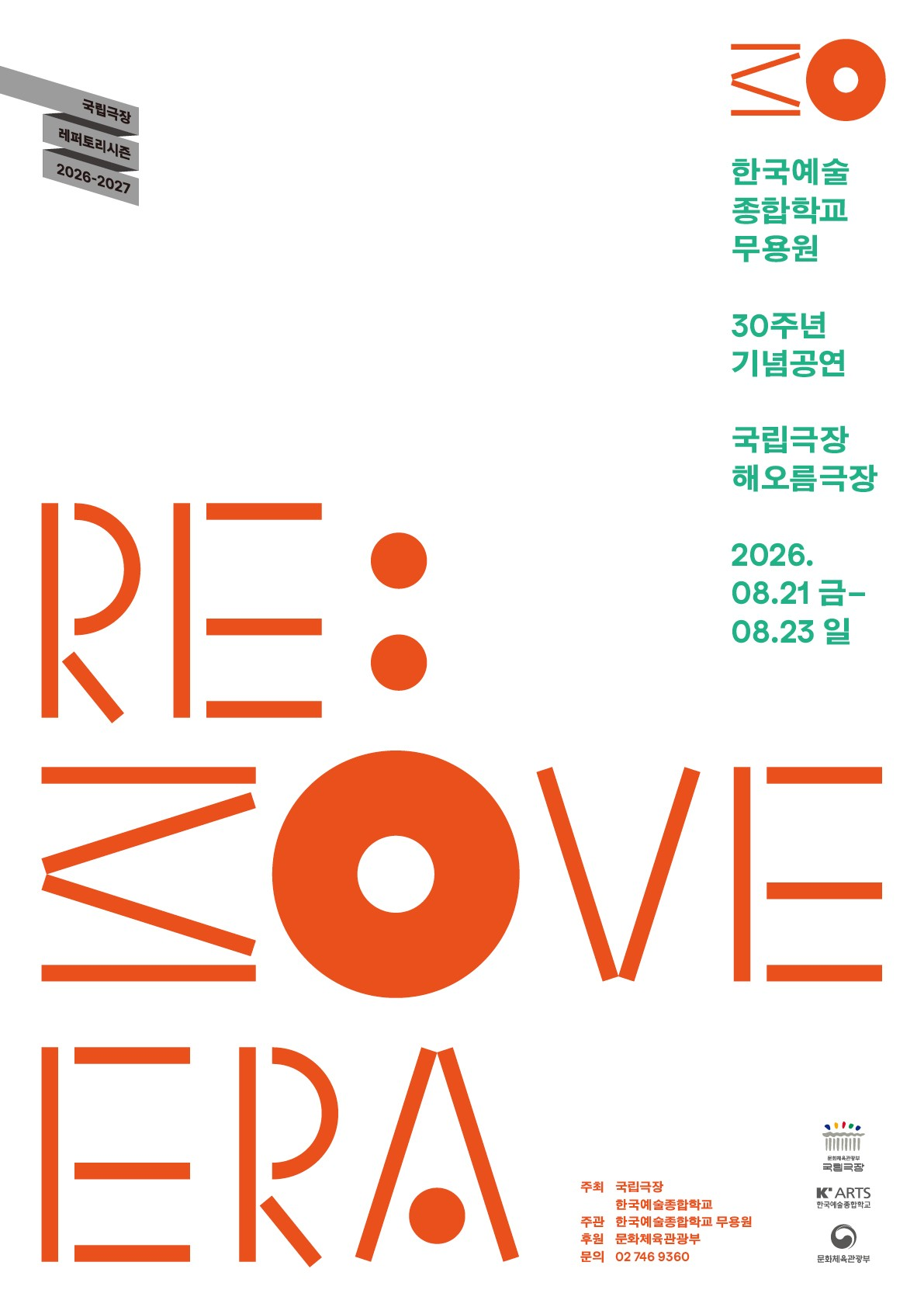
Free · Ages 7 and up · Jung-gu National Theater of Korea
[Performance Introduction] The 30th anniversary commemorative performance of the Korea National University of Arts School of Dance, 「RE: MOVE ERA」, is a special stage designed to reflect on the artistic achievements and educational values accumulated over the past 30 years and suggest new possibilities for future dance art. This performance consists of a diverse repertoire covering ballet, Korean dance, and modern dance, with alumni artists active on the world stage, faculty, graduates, and current students participating to share the history and artistic heritage established by the School of Dance. The performance title 「RE: MOVE ERA」 contains the dynamic will to trace back footprints (RE) while moving towards a new era (MOVE). Through this stage that penetrates generations and genres, it will be a meaningful journey highlighting the brilliant achievements of Korean dance art education and seeking new paradigms for future art. □ Ballet ㅇ (Time) August 21, 2026 (Fri) 19:30 ㅇ (Program) < K-ARTS BALLET: A Living Tradition > Ballet becomes our language. From the practice room to the stage, a time of embodiment. A leap towards the world, our gaze. Part 1 <K-ARTS Conservatory 2026> <K-ARTS Conservatory 2026> is a work that reconstructs the tradition of classical ballet and its meaning of inheritance on stage and adds new choreography, reflecting on the educational direction and artistic achievements accumulated by the ballet department of the Korea National University of Arts School of Dance over time. Based on strict basics and systematic education in classical ballet, K-Arts ballet has solved symbolic scenes of the traces of training engraved on the body across generations, the accumulation of such time, and the artistic lineage that continues across generations. Part 2 < Don Quixote Suite > Ballet <Don Quixote> is a colorful comic ballet depicting the cheerful love of Kitri, the daughter of a village inn, and Basilio, a poor barber, set in Barcelona, Spain, and the adventures of the wandering knight Don Quixote who helps them. This 《Don Quixote Suite》 of the Korea National University of Arts is a work newly reconstructed to fit the meaning of the 30th anniversary of the school's opening, based on Marius Petipa's choreography and Alexander Gorsky's re-choreography. Major scenes of the existing work were reconstructed so that students could more freely and diversely showcase the skills and techniques they have honed. □ Creative Dance ㅇ (Time) August 22, 2026 (Sat) 19:30 ㅇ (Program) 'Symmetry' is not a state of simple balance or perfect coincidence. It is a living connection created as different beings maintain their respective times, senses, memories, and rhythms and meet as if by chance. In a world of constant misalignment and conflict, senses expand and thoughts penetrate each other to form a new system of perception. Another being created in this way permeates into human life and newly changes the way of relationships and the sense of existence. Unpredictable reactions and moments of coincidental alignment create new flows and structures, giving birth to 'living symmetry' as a fluid balance rather than a fixed order. Ultimately, Symmetry is not a state toward perfect identity, but a reflection on the possibility of balance and connection formed by coexisting while maintaining each other's differences and imperfections, like the relationship between posthumans and humans. - Swing Again_Choreography by Ahn Sung-soo This is an upgraded version of <Swing>, which recorded a sold-out show at its premiere choreographed by Artistic Director Ahn Sung-soo at the National Modern Dance Company in 2018. It is an energetic work showing movements of various genres to the lively rhythm of vintage swing music and the dance music popular in the 1970s. Dancers present a rhythmical and lively stage to music everyone might have heard at least once, including the Swedish swing jazz band Gentlemen & Gangsters. - Looking Back at Tomorrow_Choreography by Jeon Seong-jae Performing arts speak of sustainability, but paradoxically, they are placed in a cycle of constant production and exhaustion. An environment where new ideas and senses must be obsessively created, and the costs consumed for every performance, drive art into an unsustainable system. But the body is different. Cells die and are regenerated, breathing is repeated and movement is transformed, but the physical body itself does not stop existing. When standing on stage after removing devices like colorful videos, sets, and lighting, dance returns to the most essential question. “What can be done with the body?” Even without colorful technology, the body already exists and circulates just by breathing and moving. This simplicity is the most honest possibility dance has in this era. It cautions against the phenomenon of rushing toward stages where trained bodies are disregarded and essence is lost, or flashy stage direction where huge costs are invested. It is an attempt to prove that a sufficient stage can be created only with a 'trained body and a gaze looking at the world.' Facing the 30th anniversary of the Korea National University of Arts School of Dance, I stand before the theme <Looking Back at Tomorrow>. Since its opening in 1996, the time I have been educated here and have taught students again coincides with the 30-year history of the School of Dance. Looking back at the time passed is asking about the time to come. Since my first work was put on at the Arko Arts Theater Small Theater in 2004, I dismantle and recombine the choreographic scenes and languages I have accumulated like a collage to create a new structure that reads current society. The circulation of the body does not stay on a biological level. A breathing body is a body that simultaneously obeys and resists. When humans with limitations meet, power and conflict occur. As a small game of fingertips turns into gunfire and an individual's fight expands into ideology and war, the absurd repetition of the world ultimately stems from human nature. The work unfolds this flow in the language of the body and expands the essence of circulation into three layers (1. Persistence of life, 2. Conflict between humans, 3. Yearning standing before limits). Not stopping is both salvation and punishment. Staying within that ambivalence is where this work aims to reach. □ Creative Dance ㅇ (Time) August 23, 2026 (Sun) 17:00 ㅇ (Program) - Making newness newer, women's dance –ones-_Choreography by Ahn Deok-gi (Premiere of the 56th KARTS Dance Company regular performance) Passing through the eras and reaching modern times, women's dance has established itself as a symbol of harmony and order. Fan dance, floral crown dance, sword dance, bodhisattva dance, Chunaengjeon, Taepyeongmu, and janggu dance have played important roles as art genres capturing both feminine beauty and national identity. Based on this traditional context, this work explores women's identity and social statements, aiming to express the future gender where individuals are respected beyond the dichotomy of male and female. - Hang-Out_Choreography by Jeong Jae-hyeok 'Dongrae Crane Dance' is a dance performed by idle noblemen (hallyang), characterized by its dignity, simplicity, and elegant style. Like most Korean folk dances, it is not based on shamanic or religious rituals and does not emphasize humor and satire to solve the sorrows of commoners, but has its purpose solely in the dance itself. The music of Bach, which was at the peak of the Baroque era, seems as if it was composed spontaneously, but ultimately follows principles even unconsciously. This part closely resembles the form of the Dongrae Crane Dance. <Hang-Out>, with the theme of 'upper-class play culture', discovered the motifs of dance and music, which are at the very center of dance performances, in Eastern and Western play. It studies the 'Dongrae Crane Dance' called the dance of idle noblemen among Korean aristocrats and 'Baroque era music' developed mainly by Western nobles and aims to develop it into the joy of the current era with the audience through the work. Booking: National Theater of Korea https://www.ntok.go.kr/ntok/pm/prfmng/performanceDetail.do?mi=21008&perfId=267191 Venue website: http://www.ntok.go.kr Running time: 2 hours Seat count: 2432 Parking: Available 출연: 김기민, 이은원, 한성우, 정은영, 안재용, 박선미, 전민철 등
Jung-gu National Theater of Korea
Get directions on Kakao MapNo reviews yet. Be the first to leave one.
Please write at least 10 characters. Posts containing ads or links are rejected, and posts that breach the content policy may be hidden after being reported.
Jung-gu·Myeongdong Nanta Theatre

Jung-gu·The Painters Gwanghwamun Dedicated Theater
![Poster for The Painters [Kyunghyang Art Hill]](https://www.kopis.or.kr/upload/pfmPoster/PF_PF237479_260518_151643.gif)
Jung-gu·Kyunghyang Art Hill
![Poster for Painters [Seodaemun Dedicated Theater]](https://www.kopis.or.kr/upload/pfmPoster/PF_PF242666_260810_141710.gif)
Jung-gu·NH Art Hall

Jung-gu·The The The

Jung-gu·Myeongbo Art Hall
Jongno-gu·Jeong Theater (formerly M Theater, formerly Harmony Art Hall)
![Poster for Shear Madness [Daehangno]](https://www.kopis.or.kr/upload/pfmPoster/PF_PF241378_260618_130555.gif)
Jongno-gu·Contents Box (formerly Lemaire Theater)
Jongno-gu·JTN Art Hall (formerly Daehangno Arts Madang)

Jongno-gu·Parang Theater (formerly Dohyang Art Hall, formerly Mudis Hall)
![Poster for Watch Out, Little Red Riding Hood! [Cheongju, Sejong]](https://www.kopis.or.kr/upload/pfmPoster/PF_PF150471_200629_135159.gif)
Cheongju-si·Soenaegol Small Theater
![Poster for The Cooking Magician [Daehangno]](https://www.kopis.or.kr/upload/pfmPoster/PF_PF151901_241219_103733.gif)
Jongno-gu·Delicious Theater
Jongno-gu·Jeong Theater (formerly M Theater, formerly Harmony Art Hall)
Jongno-gu·Contents Box (formerly Lemaire Theater)
Jongno-gu·JTN Art Hall (formerly Daehangno Arts Madang)
Jongno-gu·Parang Theater (formerly Dohyang Art Hall, formerly Mudis Hall)
Cheongju-si·Soenaegol Small Theater
Jongno-gu·Delicious Theater