
PaidIn 4 days
Performance
Lorchestra Inaugural Concert
Gangnam-gu·Kwanglim Arts Center
Free · Gangnam-gu UM Gallery (Yuem Gaellori)
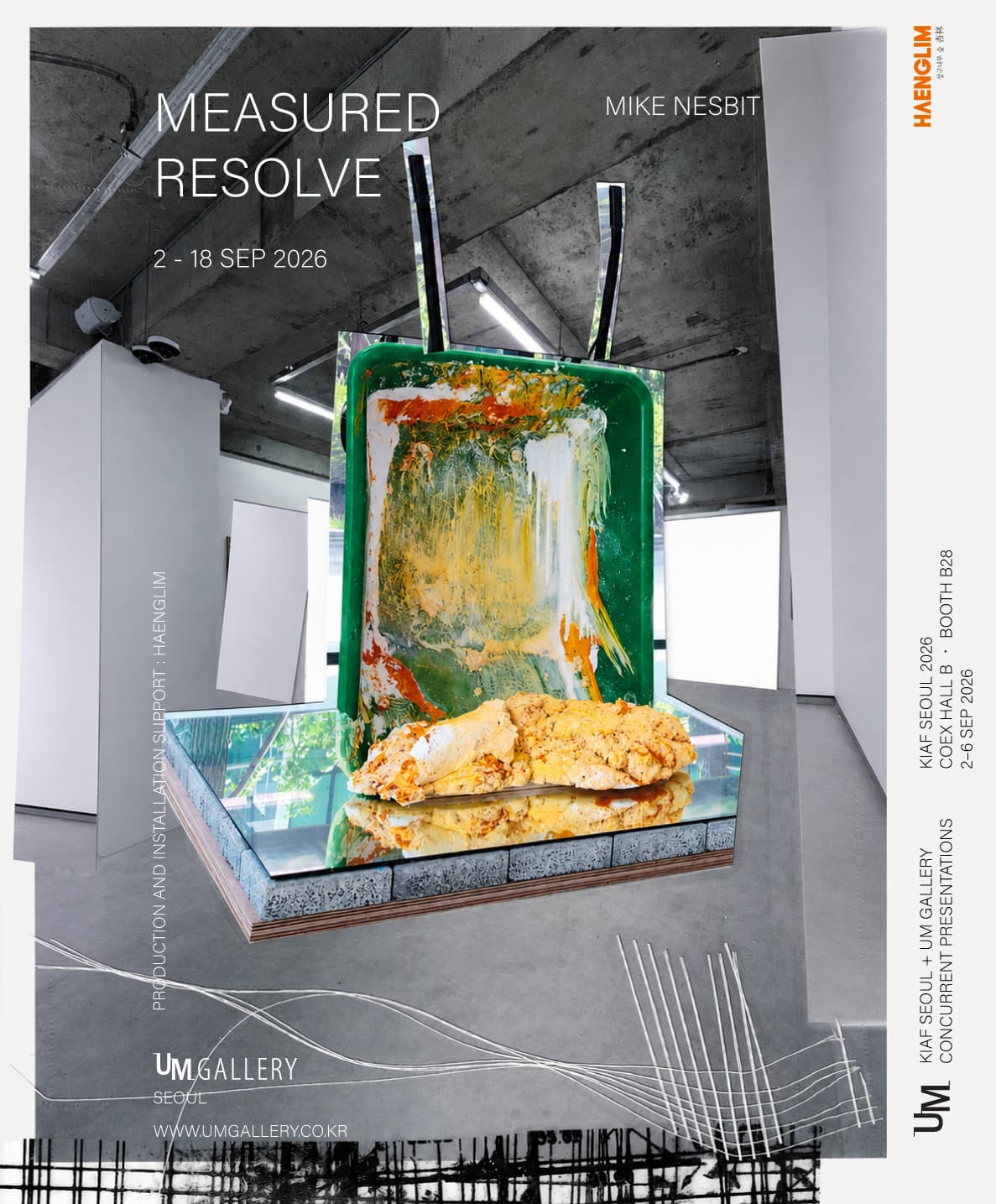
For Mike Nesbit, painting is less a bounded medium than a field of construction. Trained in architecture and shaped by work in building environments, he mobilizes concrete, timber, plywood, and steel mesh alongside the procedures through which structures are made: cutting, bracing, pouring, lifting, positioning. Materials are not neutral supports but agents that register force, gravity, duration, and contact. The image therefore emerges not from a fixed composition but from the contingencies of fabrication and site. This logic has developed across Pour Tomorrow (2025) and Built Like Us (2026). In Pour Tomorrow, the construction site and exhibition space were treated as reciprocal conditions, with formwork, tools, concrete, and labor occupying a single spatial system. Built Like Us pushed these provisional supports further into the work itself: wheelbarrows, buckets, work boots, mesh, and concrete blocks became surface, structure, and sculptural form. MEASURED RESOLVE relocates this vocabulary within UM Gallery, where the relation between object, process, and architecture becomes immediate and site-specific. The title names two interdependent modes of working. “Measured” suggests not numerical exactitude alone, but an embodied calibration of distance, balance, weight, and resistance. Structures are planned and dimensions taken, yet matter and site remain only partially governable. “Resolve” thus signifies both determination and judgment: the capacity to continue, revise, accept, or stop. Completion appears not as the realization of a fixed plan, but as a provisional resolution negotiated between intention and contingency. Here, a ladder and wheelbarrow function simultaneously as sculpture and as instruments in the making of painting. Vertical Easement was produced horizontally on the gallery floor, where contact, pressure, and material movement registered across its surface before the work was raised upright. The shift from horizontal fabrication to vertical display collapses distinctions between tool and artwork, production and exhibition. The same logic governs the floor intervention: when removing the existing tile exposed an earlier layer, Nesbit chose not to continue toward the intended concrete slab. The decision to stop turns discovery into a material form of resolve. The exhibition was realized in collaboration with Haenglim Architects & Engineers. Within a practice dependent on concrete, timber frameworks, tools, and architectural conditions, fabrication and installation do not follow conception; they are constitutive of it. Exposed floor, mirrored surfaces, ladder, wheelbarrow, and paintings operate as a shifting field of relations activated by the viewer’s movement. MEASURED RESOLVE consequently positions painting not as an autonomous object but as a spatial event produced through material, labor, architecture, and bodies in motion. For Mike Nesbit, painting is less a bounded medium than a field of construction. Trained in architecture and shaped by work in building environments, he mobilizes concrete, timber, plywood, and steel mesh alongside the procedures through which structures are made: cutting, bracing, pouring, lifting, positioning. Materials are not neutral supports but agents that register force, gravity, duration, and contact. The image therefore emerges not from a fixed composition but from the contingencies of fabrication and site. This logic has developed across Pour Tomorrow (2025) and Built Like Us (2026). In Pour Tomorrow, the construction site and exhibition space were treated as reciprocal conditions, with formwork, tools, concrete, and labor occupying a single spatial system. Built Like Us pushed these provisional supports further into the work itself: wheelbarrows, buckets, work boots, mesh, and concrete blocks became surface, structure, and sculptural form. MEASURED RESOLVE relocates this vocabulary within UM Gallery, where the relation between object, process, and architecture becomes immediate and site-specific. The title names two interdependent modes of working. “Measured” suggests not numerical exactitude alone, but an embodied calibration of distance, balance, weight, and resistance. Structures are planned and dimensions taken, yet matter and site remain only partially governable. “Resolve” thus signifies both determination and judgment: the capacity to continue, revise, accept, or stop. Completion appears not as the realization of a fixed plan, but as a provisional resolution negotiated between intention and contingency. Here, a ladder and wheelbarrow function simultaneously as sculpture and as instruments in the making of painting. Vertical Easement was produced horizontally on the gallery floor, where contact, pressure, and material movement registered across its surface before the work was raised upright. The shift from horizontal fabrication to vertical display collapses distinctions between tool and artwork, production and exhibition. The same logic governs the floor intervention: when removing the existing tile exposed an earlier layer, Nesbit chose not to continue toward the intended concrete slab. The decision to stop turns discovery into a material form of resolve. The exhibition was realized in collaboration with Haenglim Architects & Engineers. Within a practice dependent on concrete, timber frameworks, tools, and architectural conditions, fabrication and installation do not follow conception; they are constitutive of it. Exposed floor, mirrored surfaces, ladder, wheelbarrow, and paintings operate as a shifting field of relations activated by the viewer’s movement. MEASURED RESOLVE consequently positions painting not as an autonomous object but as a spatial event produced through material, labor, architecture, and bodies in motion.
Gangnam-gu UM Gallery (Yuem Gaellori)
No reviews yet. Be the first to leave one.
Please write at least 10 characters. Posts containing ads or links are rejected, and posts that breach the content policy may be hidden after being reported.
Gangnam-gu·Kwanglim Arts Center

Gangnam-gu·Kwanglim Arts Center

Gangnam-gu·Kwanglim Arts Center
Gangnam-gu·Kwanglim Arts Center

Gangnam-gu·Kwanglim Arts Center

Gangnam-gu·Gwanglim Arts Center

Gangnam-gu·Social Venue Raum
Gangnam-gu·Bongeunsa Temple, Bongeun Cultural Center

Gangnam-gu·Yagi Studio

Gangnam-gu·Gwangya Art Center

Gangnam-gu·National Library for Children and Young Adults

Gangnam-gu·Red Rouge Theater
Cheongju-si·National Museum of Modern and Contemporary Art, Cheongju (MMCA Cheongju)

Seoul Grand Park

National Museum of Korea
Yongsan-gu·Ancient Greece and Rome Gallery, Permanent Exhibition Hall, National Museum of Korea (Gungnip Jungang Bangmulgwan)
Saha-gu·Museum of Contemporary Art Busan
Haeundae-gu·Busan Museum of Art

Yeongdeungpo-gu·East Lobby, 1F, 63 Building, Yeouido

Jongno-gu·JTN Art Hall

Jongno-gu·JTN Art Hall (formerly Daehangno Arts Yard)

Cheongju-si·Soenaegol Small Theater

Jongno-gu·Daengno Hall
Cheongju-si·National Museum of Modern and Contemporary Art, Cheongju (MMCA Cheongju)

Jongno-gu·Happy Theater