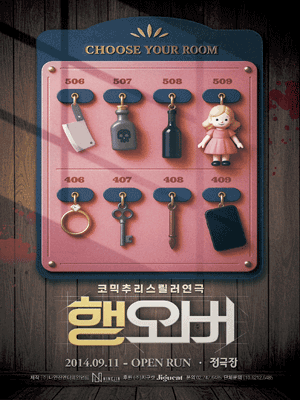
PaidOngoing
Performance
Hangover
Jongno-gu·Jeong Theater (formerly M Theater, formerly Harmony Art Hall)

Free · Ended · Jongno-gu Hori Art Space
Song Hayoung Solo Exhibition SONG HAYOUNG SOLO EXHIBITION From Boundary To Pavilion Imagine the exhibition hall as a structure, a temporary structure erected to exist for a set period without walls or roof decided. A pavilion, a building that is temporary but chooses the density of the present moment. This new work, as artist Song Hayoung mentions, "starts from the modularity, temporality, layering, and open structure where the inside and outside of the pavilion connect." The artist seems to say that painting can also exist in that way. Rather than hardening into a fixed conclusion during the exhibition, the artist hopes it will be a place where the viewer's senses and thoughts move in a way different from usual. What constitutes that open structure is 'boundary', a subject he has continuously explored. The artist captures this 'boundary' mostly during travel, rather than as a special place, like facing a landscape that has already passed while sitting in a backward-facing seat of a train. The landscape gazed at with a time lag feels different depending on the direction and speed. The outer walls of buildings, the reflection of glass windows, temporary structures of construction sites, and traces of time left on old surfaces pass by and catch the eye. For him, these moments are closer to states where time and direction, surfaces and traces, light and reflection overlap, rather than fixed landscapes. What he captures in the city is not a specific place or scene, but the process itself where senses appear, disappear, and remain as traces within it. The boundaries captured this way contain various expressions. While there are clearly divided points like road lines and corners of structures, there are also points where overlapping and meeting occur simultaneously, like places where light and shadow slowly overlap, or moments when color gradually changes into another color. If the former is the artificial and orderly boundary of the city, the latter is the fluid and sensory boundary of nature. On the screen, this boundary is translated in different ways. Sharp boundaries are represented by lines, permeating boundaries by planes pushing and pulling and intersecting, and dots are placed where light temporarily forms or gaze stops. Ultimately, since a boundary is a line that divides something, the core that has led his work is that it is a point of contact where different things face each other and form relationships. If they had not been divided, they would not have met in the first place. Division is not a lack of relationship, but a prerequisite for a relationship to be established. What he transfers to the screen is not the landscape in front of him itself, but the layers of speed and distance, temperature and emotion that are within that landscape but rarely revealed. Instead of transferring visible scenes as they are, the artist translates the invisible senses and realms of perception hidden inside into the language of color planes and structures. This subject has been revealed through various works over ten years. In the early 2010s, the artist began by painting images of people and objects on circular frames or wooden furniture. In the narrative scenes placed on the circular frames of 《Hot Place》(2013) and the benches and tables of 《Time to leave》(2014), interest in stories and objects remained stronger than concepts. In the process of taking away stories, what the artist focused on next was not the narrative on the object, but the frame itself that contained that narrative. Around 2017, the screen becomes rapidly restrained, and the palette narrows to blue and achromatic colors. The diamond canvas of 《Boundary》(2017) and the screen with floating squares show that the shape of the canvas itself began to be treated as a matter of boundaries. While dealing with flat painting for a long time, the question 'how far can the surface of painting expand' naturally followed the artist. If boundaries are viewed as fluid relationships rather than fixed lines, the thought reached that the surface of painting can also move with the surrounding space without being trapped in two dimensions. This idea pushed painting out of the canvas in 2020. In the neon lighting of 《Chasm (things that were shining in between)》(2020) and 《Beyond the times》(2020), monochromatic panels and tile pieces stand leaning against the space. As conditions such as light and reflection, movement, and the position of the viewer passing in front of it rushed into the work, the painting transformed into a structure that responds differently each time. The thought that the impression changes whenever the viewing angle, posture, and body position change, and wanting to embrace that change itself as part of the work, penetrates this period. It was close to an attempt to measure the width that painting can embrace again. Since 2022, the artist has explored modular forms where small units gather to form a whole, choosing highly saturated colors. They connect like ribbons along the wall as in 《Contraction and Expansion》(2022), or geometric pieces of 《Reassemblage》(2023) repeat in a grid. The afterimages of light and movement created by the pieces repeated on the grid shift the artist's interest from the structure itself to the phenomenon of light created by that structure. In 2024, light escapes metaphor and is drawn in direct forms. Through various media and compositions, from the converging white triangles of 《Flare & Highlight》(2024) to the recent work 《Sequence: Overlay》(2025) which implements a canvas actually moving by a motor, he experimented with how far the surface of painting can expand. Behind all these expansions lies an attitude toward restraint. Although heterogeneous scenes such as architecture, music, city scenes, and contemporary speed are mixed throughout the work, those scenes are not revealed on the screen as they are. The work remains in the form of simple and restrained color-field abstraction. The artist's attitude of setting concepts and structures first before executing the work leads this process. How it will be delivered to the viewer when several layers of embodied senses are compressed into a few colors, planes, and structures is the point where he stays longest in front of the screen. The time of stacking layers is also a practice of learning that restraint with the body. Once colors are decided and the brush starts to move, one stays on the screen without distraction in the repeated acts. While continuing brushstrokes with an even rhythm, the depth and density of color, and the intended texture gradually accumulate inside the screen. This exhibition is a return to the oldest condition of painting facing the viewer standing in front of the wall, after all these experiments. This return reveals the questions accumulated so far in the most refined format. In the new works, colors have noticeably decreased. Works in the yellow spectrum are close to the sense of opening and passage. Yellow, which simultaneously embraces light, signals, and ventilation, varies in temperature and density depending on the combination and arrangement. In the orange spectrum, that sense appears in a more compressed and material state. With warm yet strong density, it reveals the tension and structure inside the screen more clearly. These colors are fished from daily senses, urban surfaces, shaking boundaries, and contemporary rhythms. There is no set rule for deciding colors. There is only endless time spent retracing what temperature, density, and tension are created when that color is placed next to another color on the screen. That process is ultimately no different from the attitude of not defining boundaries as a single conclusion but continuously expanding them anew. As surfaces mixed with pearl and silver are added, what looked like a single color from the front approaches with a different temperature when the position is shifted slightly. The physical level difference created by stacking multiple layers of canvas is also the same logic. Layers are not physical thickness but a way colors and structures accumulate, and at the same time, another condition for painting to stretch toward space. The composition of the exhibition hall is also more restrained than before. Unlike previous exhibitions that detached works from the wall using devices like aluminum profiles or motors and actively dragged in space, this time chose the most traditional method of painting where the canvas is hung on the wall and the viewer stands in front. However, this simplicity is not empty. Within the limited colors and elements, the balance and tension created by color planes and lines are tuned more sensitively. The work proposes to look close, from the side, and then far away again. Approaching, the level differences where color planes meet, the density embedded in the surface, and the impression of color shifting depending on the direction of light enter the eye. Backing away, the moment comes when those individual senses integrate into a single structure and rhythm. The screen is not completed at any one point but continues to change according to the viewer's position and movement. When the exhibition ends, this temporary structure will be dismantled without a trace. However, the senses that were open between colors and planes for a while will persist in their own ways.
Jongno-gu Hori Art Space
Get directions on Google MapsNo reviews yet. Be the first to leave one.
Please write at least 10 characters. Posts containing ads or links are rejected, and posts that breach the content policy may be hidden after being reported.
Jongno-gu·Jeong Theater (formerly M Theater, formerly Harmony Art Hall)
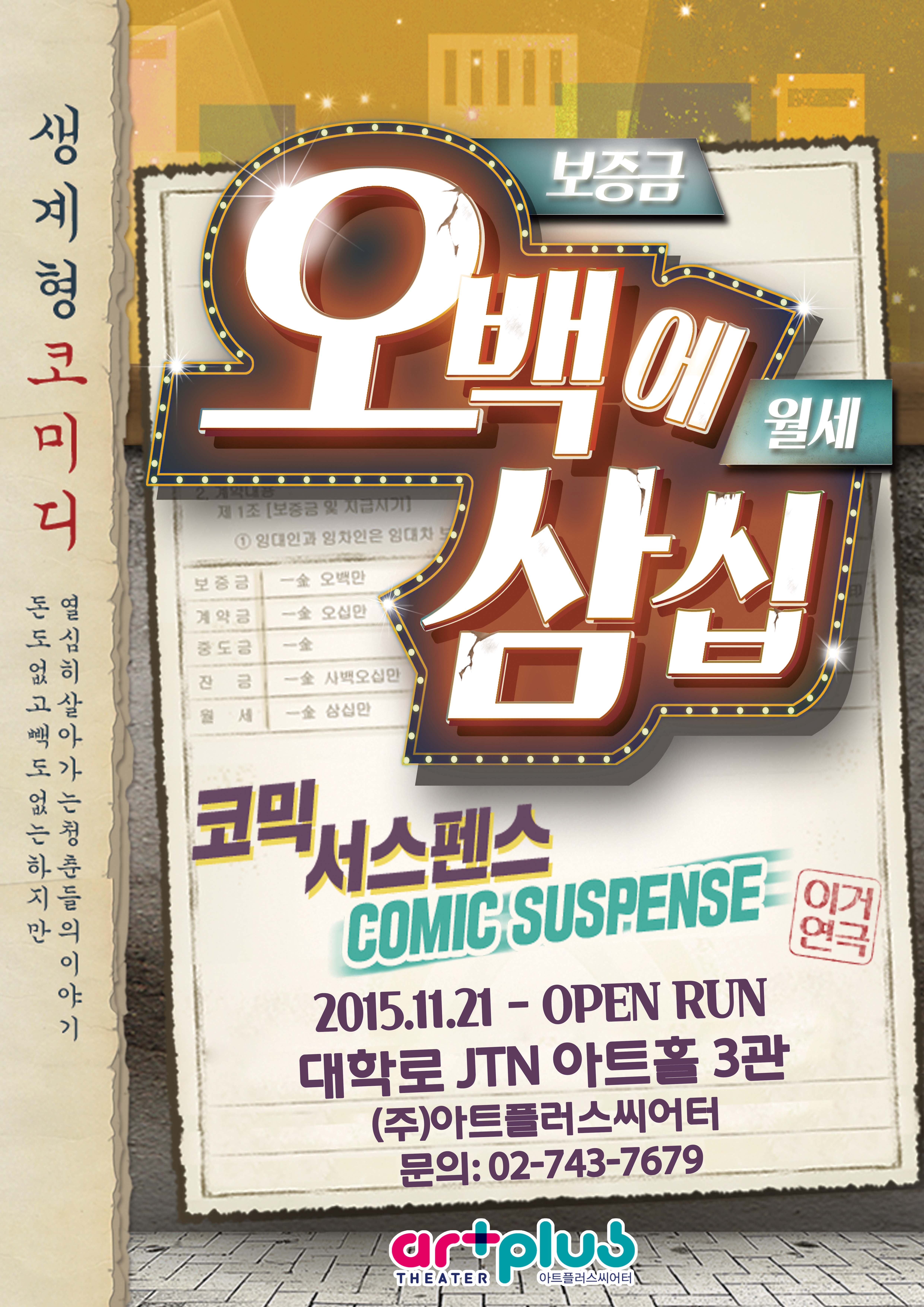
Jongno-gu·JTN Art Hall

Jongno-gu·Contents Box (formerly Le Meilleur Theater)

Jongno-gu·JTN Art Hall (formerly Daehangno Arts Madang)

Jongno-gu·Parang Theater (formerly Dohyang Art Hall, formerly Mudis Hall)

Jongno-gu·Delicious Theater
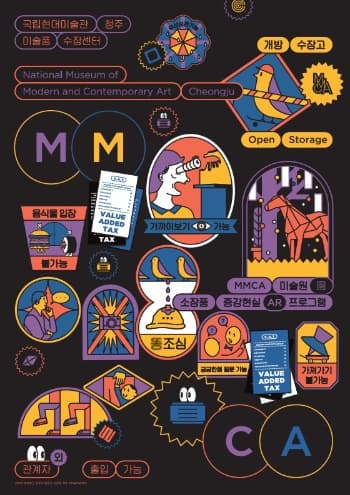
Cheongju-si·National Museum of Modern and Contemporary Art, Cheongju (MMCA Cheongju)

Seoul Grand Park

National Museum of Korea
Yongsan-gu·Ancient Greece and Rome Gallery, Permanent Exhibition Hall, National Museum of Korea (Gungnip Jungang Bangmulgwan)
Saha-gu·Museum of Contemporary Art Busan
Haeundae-gu·Busan Museum of Art

Yeongdeungpo-gu·East Lobby, 1F, 63 Building, Yeouido
Jongno-gu·Jeong Theater (formerly M Theater, formerly Harmony Art Hall)
Jongno-gu·JTN Art Hall
Jongno-gu·Contents Box (formerly Le Meilleur Theater)
Jongno-gu·JTN Art Hall (formerly Daehangno Arts Madang)
Jongno-gu·Parang Theater (formerly Dohyang Art Hall, formerly Mudis Hall)

Cheongju-si·Soenaegol Small Theater